Efficiency is one of the most important skills for entrepreneurs, freelancers and small business owners. When you start or run a company, time is limited, tasks pile up, and there is rarely room to waste hours on the wrong work. At Flexum Coworking we write about efficiency because we meet entrepreneurs every day who want better results – without burning out.
This category collects our articles on productivity, time management, working from home and practical methods you can use immediately. The goal is not theory for its own sake, but useful guidance: how to prioritise, focus and get more out of your working day.
Why does Flexum write about efficiency?
Flexum helps companies with professional foundations: virtual office, business address, mail handling and flexible rooms in Copenhagen. But we also know that an address and a subscription are not enough. Success depends on how you use your time. That is why we share knowledge about efficiency – so entrepreneurs can spend energy on customers, sales and growth instead of calendar chaos.
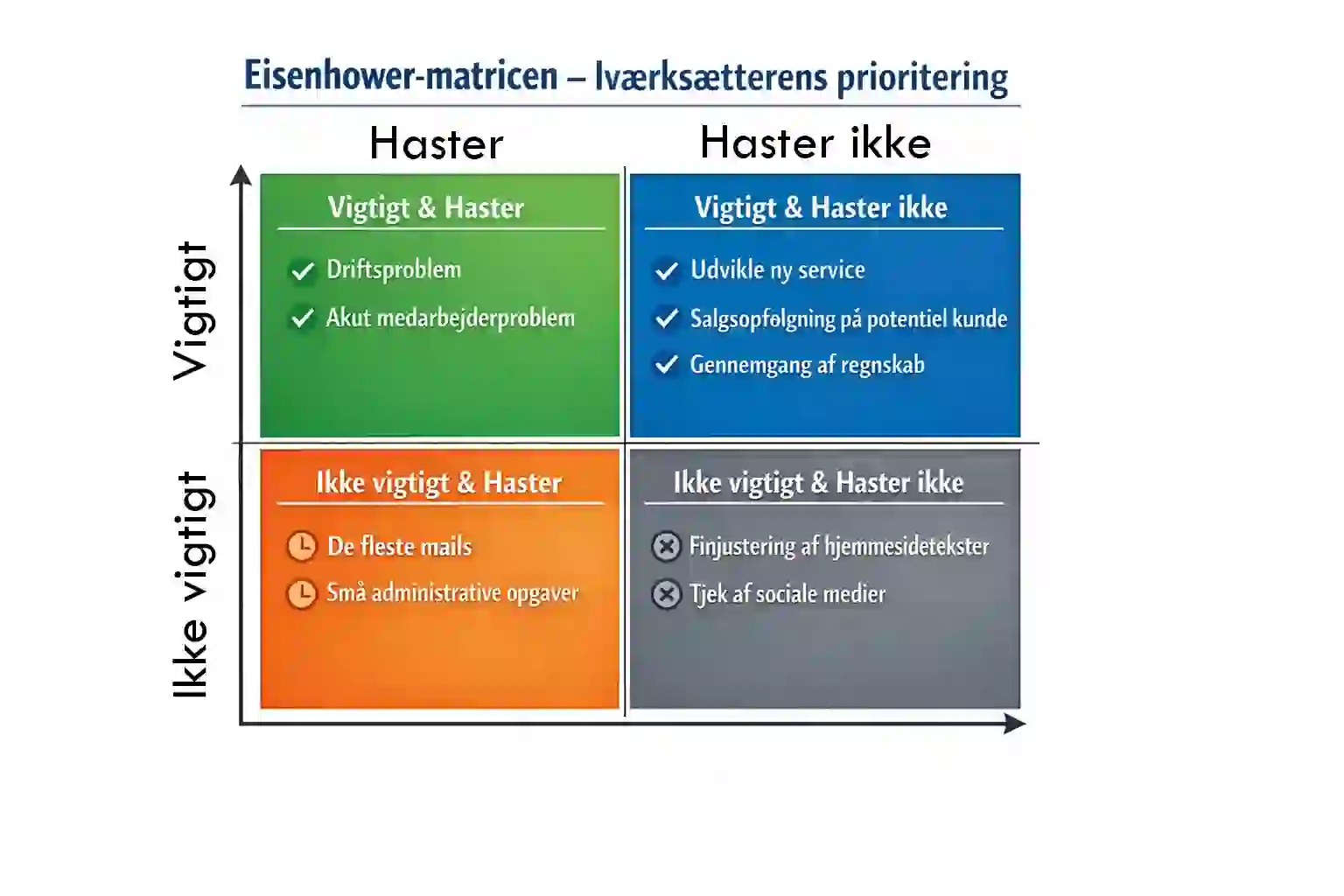
Many new business owners work from home, switch between tasks all day and try to cover administration, marketing and product work at once. Without structure, days become long and progress stays small. The articles in this category give concrete tools: prioritisation, focus blocks, home-office habits and methods such as the Eisenhower Matrix and the Pomodoro Technique.
What does efficiency mean for an entrepreneur?
Efficiency is not about working the highest number of hours. It is about working on the right things – in the right order. For an entrepreneur that can mean answering important emails first, blocking time for deep work, declining meetings without a purpose, and separating what feels busy from what actually creates value.
When you run a company alone or in a small team, there is no large organisation keeping you accountable. You must create your own rhythm. That is why we write about methods that are easy to start with and that fit a day full of customers, deadlines and unexpected tasks.
Common challenges we see
Entrepreneurs often tell us that they:
- start the day without clear priorities
- get interrupted by notifications and small tasks
- mix private life and work, especially from a home office
- spend too long on administration
- hold meetings that do not lead to decisions
- feel behind even when they work a lot
These problems are normal – and solvable. Better time management gives you more capacity for what moves the business forward: sales, delivery and relationships.
What you will find in the articles
In the Efficiency category you can read about the Pomodoro Technique, time-management tips, pros and cons of working from home, and the Eisenhower Matrix. The articles are written so you can try the ideas quickly. You do not need a complex system. Start with one habit, measure the effect for a week, then build from there.
We recommend combining the methods with good work foundations. A virtual office can remove noise from a private address and mail. A meeting room when needed makes customer meetings more professional. And a clear daily structure helps you actually use those options.
Efficiency and company formation belong together
When you form a company, many practical tasks appear at once: CVR, banking, contracts, documentation and communication. Without prioritisation, the start-up phase feels overwhelming. That is why we see efficiency as part of the same journey as company formation and day-to-day operations.
The earlier you learn to manage time and focus, the easier growth becomes. We also write about the topic openly and for free because we want to help entrepreneurs avoid expensive mistakes – both in legal setup and in working habits.
How to use this page
Choose an article above that matches your biggest challenge right now. Read it, pick one concrete action, and test it in your own week. Come back when you are ready for the next step. You can also browse more topics under all articles or get help via our support pages.
At Flexum we believe useful knowledge should be practical. Efficiency is not a buzzword – it is a tool that gives you freedom to build the company you want. Use the articles here as a starting point and adapt them to your reality.
If you have questions about combining better work routines with virtual office, mail handling or rooms in Copenhagen, you are always welcome to contact us. We are happy to help – from the first steps to a more structured working week.