
As an entrepreneur, it is rarely the work that is lacking. It is the overview. Many work hard, but on the wrong things—and end up being busy without making real progress. The Eisenhower Matrix is one of the oldest and most effective tools for solving exactly that problem.
The technique is simple, disciplined, and proven. It comes from a time when leadership was about responsibility and prioritization—not apps and notifications.
What is the Eisenhower Matrix?
The Eisenhower Matrix is named after Dwight D. Eisenhower, former U.S. president and general. He was known for his ability to make clear decisions under pressure.
The matrix is based on one crucial insight:
There is a difference between what is urgent—and what is important.
Tasks are divided into four categories based on two questions:
- Is the task important?
- Is the task urgent?
The result is a matrix with four quadrants.
The four quadrants of the Eisenhower Matrix
1. Important and urgent — Do it now
These are tasks that:
- Have direct consequences if they are not completed
- Are often crises, deadlines, or urgent problems
Examples:
- An important customer is dissatisfied
- An invoice with a payment deadline today
- A system is down
👉 These tasks must be handled immediately. But if your day is dominated by this quadrant, it is a warning sign.
2. Important, but not urgent — Schedule it
This is the most important quadrant in the matrix—and the most overlooked.
This is where you find:
- Strategic work
- Business development
- Planning
- Skills development
- Relationships
Examples:
- Developing new products
- Working on sales strategy
- Improving internal processes
- Long-term planning
👉 Successful entrepreneurs spend most of their time here.
👉 Less successful ones talk about it—but never get it done.
3. Not important, but urgent — Delegate it
These tasks:
- Create noise
- Feel pressing
- But create limited value
Examples:
- Many emails
- Minor administrative tasks
- Interruptions
- Routine tasks
👉 If you do everything in this quadrant yourself, you are working in the business—not on it.
4. Not important and not urgent — Eliminate it
This is a waste of time.
Examples:
- Unnecessary meetings
- Excessive use of social media
- Tasks with no clear purpose
👉 These tasks should either be removed entirely or minimized significantly.
Example: The Eisenhower Matrix in an entrepreneur’s day-to-day
Imagine an entrepreneur running a small business and starting the workday at 8:00.
Tasks on the table:
- 25 new emails
- A potential customer needs to be called back
- An employee has a problem
- Accounts need to be reviewed
- Work on a new service
- Update the website
- An unexpected operational issue
When the tasks are sorted into the matrix:
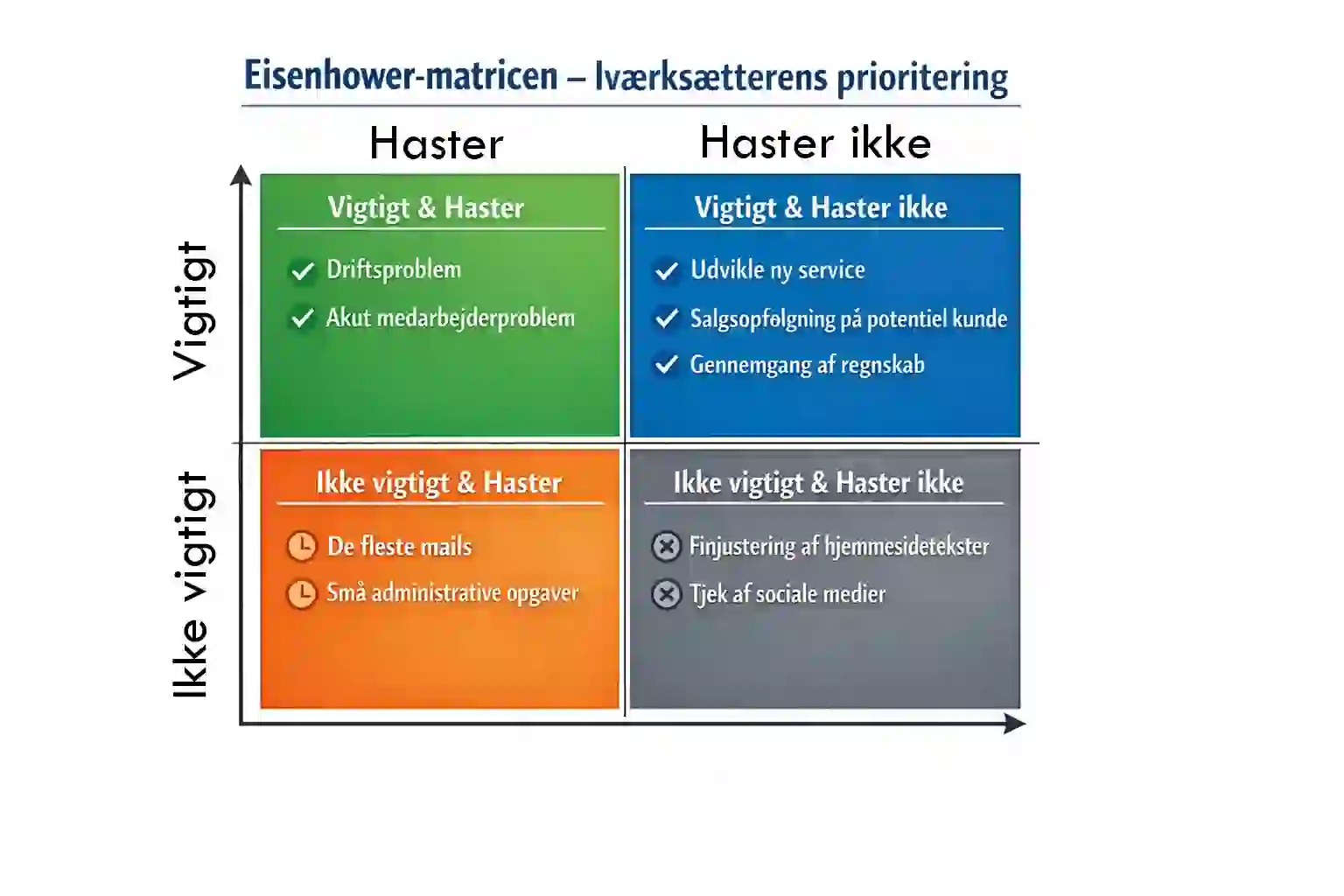
- The operational issue
- The employee’s urgent problem
Important & not urgent
- Work on a new service
- Sales follow-up with a potential customer
- Review of accounts
Not important & urgent
- Most emails
- Minor administrative tasks
Not important & not urgent
- Fine-tuning website copy with no impact
- Checking social media
The result
Instead of starting the day in the inbox, the entrepreneur first resolves the urgent issues—and then blocks time in the calendar for what is important but not urgent.
This is where the difference emerges between running a business and merely keeping it going.
How to use the Eisenhower Matrix in practice
- Write down all your tasks
- Sort them honestly into the four quadrants
- Schedule time for quadrant 2—before the calendar fills up
- Delegate consistently
- Eliminate tasks with no real value
Important:
The matrix only works if you use it continuously. Not once—but every week.
The classic lesson
The Eisenhower Matrix is not about working faster.
It is about working on the right things.
Entrepreneurs who succeed in the long term are not those who are the busiest—but those who are best at prioritizing.
And that discipline starts here.
As an entrepreneur, efficiency is also about choosing the right solutions. A virtual office at Flexum Coworking frees up time and resources, so you can focus on what matters.